Microfluidic LNP Formulator
Contributed to the design of the clamping mechanism and pressure manifold for a custom microfluidic chip interface, improving reliability and speed of operation and laying groundwork for future full-workflow automation.
Existing workflows relied on handheld operation of the pressure manifold, which was slow and prone to gas leakage from misalignment, and could risk experimental runs if the handle dislodged mid-run. The workflow was further slowed by needing two separate pressure manifolds — one for formulation and one for the cleaning procedure.
- •Contributed to simplifying the manifold into a single connector with a tight, quick-release clamping mechanism, as part of a larger team effort.
- •Used Fusion 360 to implement CAD revisions to the pressure manifold, mounting plate, collar, handle, and related components based on detailed design requirements.
- •Redesigned the chip inlet, plate, collar, and handle, including O-ring sealing features and guide-rod geometry.
- •Produced and assembled DLP and FDM 3D-printed prototypes, checking component fit and alignment and adjusting dimensions, tolerances, printability, and assembly features based on test feedback.
- •Researched and prototyped multiple compact locking mechanisms with quick-release, with durability as a key design consideration.
- •Explored concepts for highly accurate, low-volume microfluidic control, with an eye toward future automated chip initialization.
The single manifold for LNP formulation and chip cleaning is now in active use, and the high-accuracy microfluidic control work is being developed further based on the initial proposals.
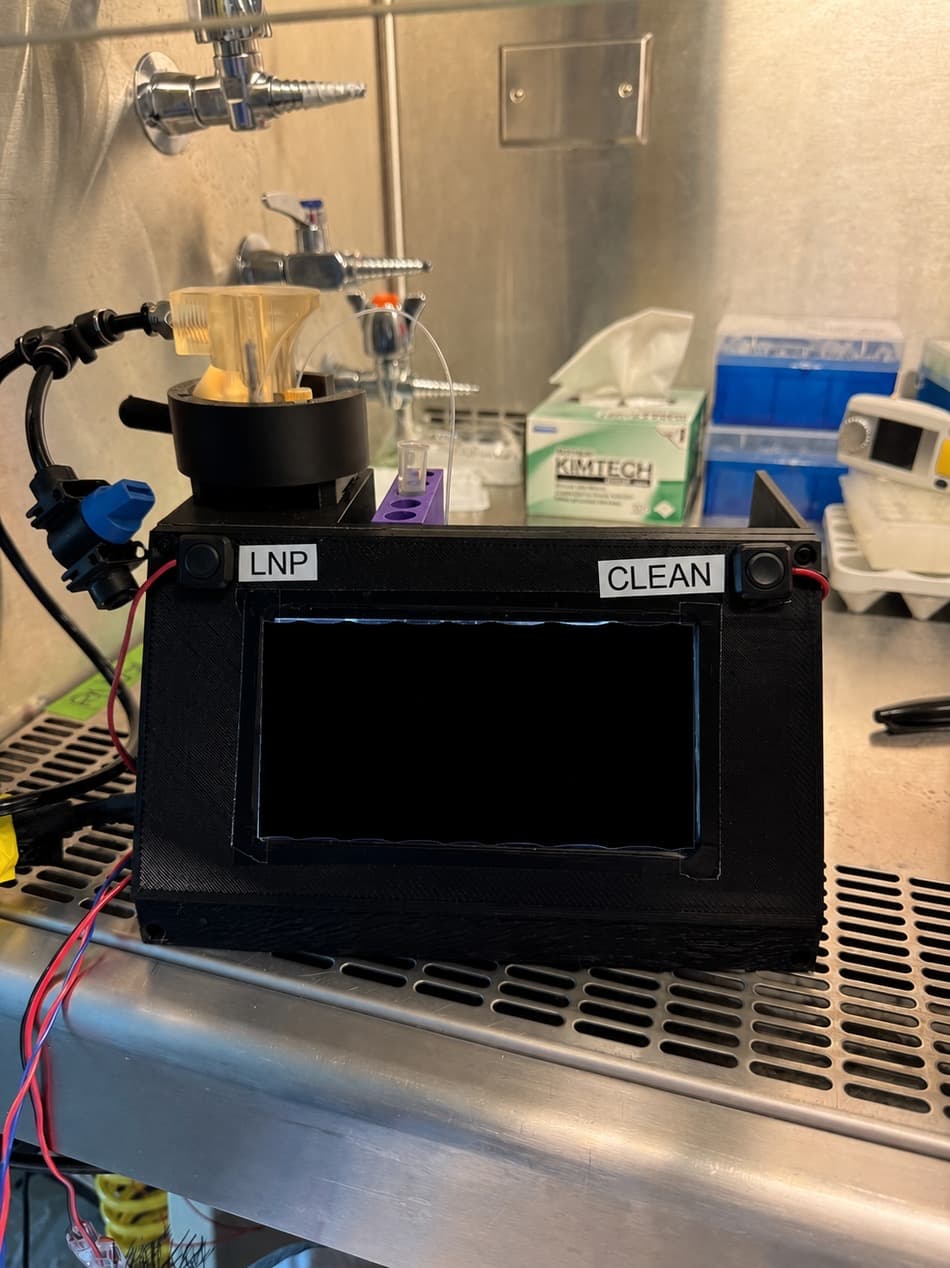
The assembled microfluidic LNP formulator: 3D-printed enclosure, Raspberry Pi touch control with LNP and CLEAN routines, and the chip manifold mounted above.